Machine Specification
| Feature |
Specification |
| Product Name |
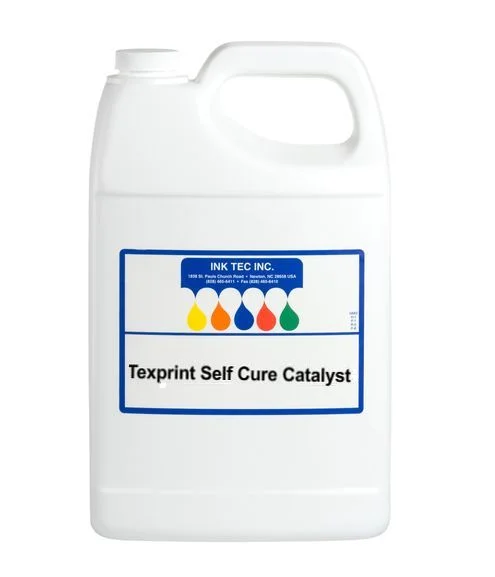
Texprint Self-Cure Catalyst |
| Manufacturer |
Ink Tec Inc. |
| Country of Origin |
USA |
| Product Type |
Printing ink Self Cure Catalyst / Additive |
| Primary Function |
Enhances ink durability and wash-fastness without requiring heat curing. |
| Recommended Addition |
5-8% of the ink weight. |
| Curing Time |
Gels and hardens within 24 hours. |
| Compatibility |
Specially formulated for use with Texprint ink series. |
| Packaging |
1 kg, 5 kg containers (packaging may vary). |
| Storage |
Store in a cool, dry place away from direct sunlight. |
| Net Contents |
Varies by packaging. |
When to use a self-cure catalyst
Standard textile screen printing inks cure by heat — a flash dryer, a tunnel dryer, or a heat press. That works well for most workshops but not always: some fabric types are heat-sensitive (delicate blends, thermal materials), some small workshops don’t have curing equipment yet, and some job types (specialty finishes, mixed-substrate items) benefit from a chemical cure instead of thermal.
The self-cure catalyst enables Ink Tec Texprint inks to cure at ambient temperature after mixing. The trade-off is that mixed ink has a limited pot life (typically 8–12 hours) before it starts to cure in the container — so it is mixed batch-by-batch rather than kept in a large tub across shifts. For the workshops that need it, this is a small operational adjustment for a real capability gain.
Applications
Bangladesh workshops that use this catalyst are typically small-to-mid screen printing operations that haven’t yet invested in a tunnel dryer or flash cure setup, plus specialty printers working with heat-sensitive fabrics (delicate blends, thermal reflective materials, some technical apparel). It is also useful for on-site printing at events and pop-up locations where curing equipment isn’t practical.
For a workshop planning to buy a tunnel dryer or flash cure in the future, self-cure catalyst is a bridge — it lets the workshop take real print orders now while capex is being planned. Once curing equipment is installed, the workshop can move to standard heat curing for higher throughput.
Related equipment and supplies: Texprint Rotary Ink, Texprint Ink Reducer & Thinner, Colortex Screen Ink.
Frequently Asked Questions
What is the pot life after mixing catalyst into ink?
Typically 8–12 hours at ambient Bangladesh temperature. Mixed ink starts to cure in the container over that period, so it is mixed batch-by-batch rather than kept for days. Plan mixing per shift.
Is the print wash-fastness the same as heat-cured?
Comparable when applied correctly at the right addition rate. Heat-cured prints have marginally better wash-fastness but self-cured prints still meet standard buyer specifications (typically 25+ washes without significant fade).
What addition rate should I use?
Typically 3–5% by weight of ink. Higher addition speeds cure time but shortens pot life. Follow the manufacturer’s recommendation on the container label for the specific Texprint grade you are using.
Can I use this catalyst with Colortex plastisol ink?
No — this catalyst is matched to Texprint water-based ink ranges. Plastisol inks (including Colortex plastisol grades) require heat curing and cannot be air-cured with this catalyst.
How long does the cured print take to reach full wash-fastness?
The print is dry to touch within 30–60 minutes but reaches full wash-fastness after 24–48 hours at ambient temperature. Recommend customers wait at least 24 hours before first wash.
Is the catalyst safe to handle?
Standard PPE (gloves, eye protection) recommended during mixing. Follow standard safety practice for any print chemical. Safety data sheet available on request.