Machine Specification
| Model |
Heating area |
Temp |
Time range |
Voltage |
Power |
Packing size |
GW |
| PT-J401 |
400*500mm |
260℃ |
0-999s |
220V |
400KW |
580*470*540mm |
41.5KG |
| PT-J402 |
400*600mm |
260℃ |
0-999s |
220V |
3KW |
1220*750*65mm |
130KG |
| PT-J403 |
500*700mm |
260℃ |
0-999s |
220V |
3KW |
640*1020*960mm |
150KG |
| PT-J404 |
600*800mm |
260℃ |
0-999s |
380V |
4.5KW |
1800*980*1500mm |
370KG |
| PT-405 |
600*800mm |
260℃ |
0-999s |
380V |
6KW |
1900*1000*1500mm |
390KG |
Where the throughput gain actually comes from
On a single-station heat press, the cycle is: load, press, wait, unload, load again. The press sits idle while the operator handles the garment, and the operator stands idle while the press runs its cycle. Roughly half of both resources are waiting at any moment.
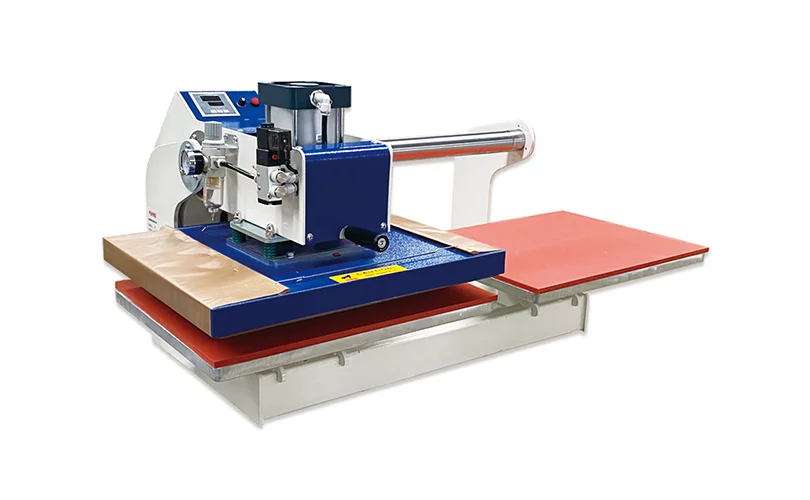
A double-station press removes that waiting. The heated head shuttles between two platens, so while one garment is being pressed the operator is loading the next. The press runs near-continuously and the operator works continuously. For a Bangladesh factory running heat transfer on volume orders, this typically means close to double the output from the same operator and the same floor space — which is why it is usually the first upgrade a growing heat-transfer operation makes.
Applications
Garment factories and print operations use double-station presses for applying heat transfers, DTF prints and vinyl to T-shirts, polos and sportswear at production volume. Export-order work benefits most, since those runs are large and consistent enough to keep both stations busy through a shift.
The press applies transfers produced on our DTF Printer and works with the heat transfer inks in our consumables range. Factories running DTF at volume usually pair the printer, the curing oven and a double-station press as one production line.
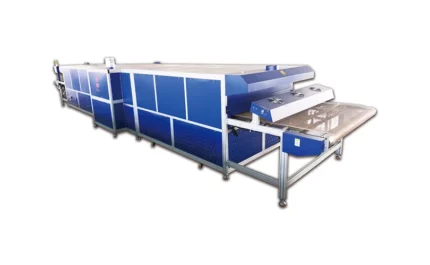
In a higher-throughput DTF line, a DTF printer produces the transfer, a suitable industrial curing oven can support the powder-curing stage, and this press applies the finished transfer. For lower-volume work with frequent operator-controlled changes, compare the semi-automatic double-position press.
Frequently Asked Questions
How much more output does a double station give over a single station?
Close to double in practice, because the press is no longer idle during loading. The exact gain depends on how long your press cycle is relative to garment handling time — short cycles with slow handling see the biggest improvement.
What can it apply?
Heat transfers, DTF prints, heat transfer vinyl and sublimation onto finished garments. Settings differ by transfer type and are covered in operator training.
What platen sizes are available?
A range of platen sizes to suit garment work. Tell our sales team your typical print area and garment sizes and we will recommend the right configuration.
Is it safer than a single-station press?
Generally yes, because the operator loads a platen that is away from the heated head rather than reaching under it. Standard heat press safety practice and training still apply.
What power supply does it need?
Typically a three-phase industrial supply depending on platen size and heater rating. Full electrical specifications are supplied with the quotation so the connection can be prepared before delivery.
What is the delivery timeline in Bangladesh?
30–45 days from order confirmation to Chittagong port, plus 5–7 days for inland transport, installation and operator training.