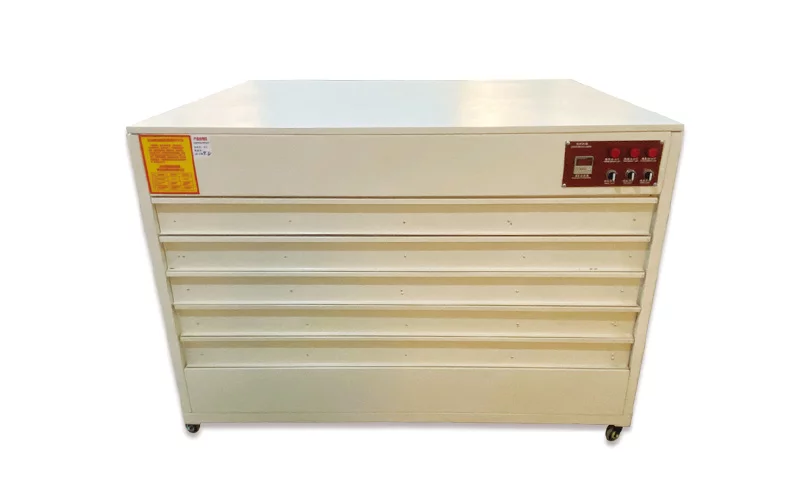
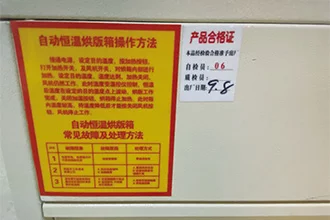
Machine Specification
| Model |
Machine Dimension(mm) |
Max Screen Area(mm) |
Number of Plate |
Temp range |
Voltage |
Power |
G.W. |
| PT-G101 |
1200*900*900 |
800*1000 |
5 |
Room temp.-50°C |
220 |
3.2KW |
100 |
| PT-G102 |
1500*1200*900 |
1000*1300 |
5 |
Room temp.-50°C |
220 |
4KW |
130 |
| PT-G103 |
750*600*350 |
640*530 |
4 |
Room temp.-50°C |
220 |
1.5KW |
70 |
Why coated screens need a cabinet, not a corner
Freshly coated emulsion stays tacky for hours and attracts every airborne particle in the room. In a working Bangladesh print shop — lint from fabric, dust from the street, ink spray — a screen left drying in the open picks up contamination that shows up as pinholes and blemishes in the finished stencil. Those pinholes print as ink spots on every garment in the run.
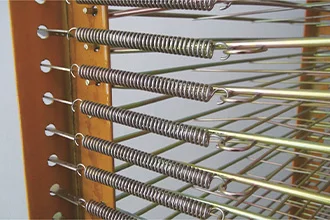
A drying cabinet solves both problems at once. The enclosure keeps dust off the wet emulsion, and the warm circulated air cuts drying time from several hours to under an hour. For a workshop preparing twenty or more screens a day, this turns screen drying from an overnight wait into a same-shift step, which means screens coated in the morning can print in the afternoon.
Applications
Screen printing workshops use this cabinet for drying freshly coated screens before exposure, and for drying reclaimed screens after washing and degreasing. Garment printers preparing multi-colour screen sets benefit most, because all four screens dry under identical conditions and therefore expose identically.
The cabinet sits between our Automatic Emulsion Coating Machine and the Micro-Computer Screen Exposure Machine in the screen-preparation workflow. Workshops needing drying plus registration capability should look at our Oriented Plate Screen Frame Dryer, which adds a built-in calibration table.
Explore related equipment and supplies: Automatic Emulsion Coating Machine, Oriented Plate Screen Frame Dryer, Micro-Computer Screen Exposure Machine.
Frequently Asked Questions
How long does a coated screen take to dry in the cabinet?
Typically 30–60 minutes depending on emulsion thickness, coating passes and cabinet temperature — far faster than the 4–8 hours of open-air drying, and much faster again than air drying during monsoon humidity.
Is the cabinet light-safe for emulsion?
Yes — the enclosure is constructed to keep ambient UV off the emulsion during drying, so screens do not pre-expose while they dry. Keep the workshop’s own UV sources away from the cabinet as standard practice.
What drying temperature should I use?
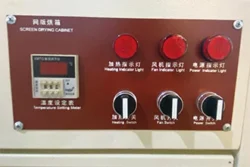
Moderate warmth is correct — excessive heat can pre-cure emulsion and make the stencil harder to wash out. The thermostat lets you set a safe temperature; operator training covers the right setting for common Bangladesh emulsions.
How many screens does it hold per cycle?
Depends on the cabinet size and your frame dimensions. Tell our sales team your typical frame size and daily screen count and we will recommend the right capacity.
Can I use it to dry reclaimed screens after washing?
Yes — drying reclaimed screens before recoating is a common secondary use, and doing it in the cabinet rather than in the open keeps dust off the mesh before the next coat goes on.
What is the delivery timeline in Bangladesh?
30–45 days from order confirmation to Chittagong port, plus 5–7 days for inland transport and installation including electrical connection.